
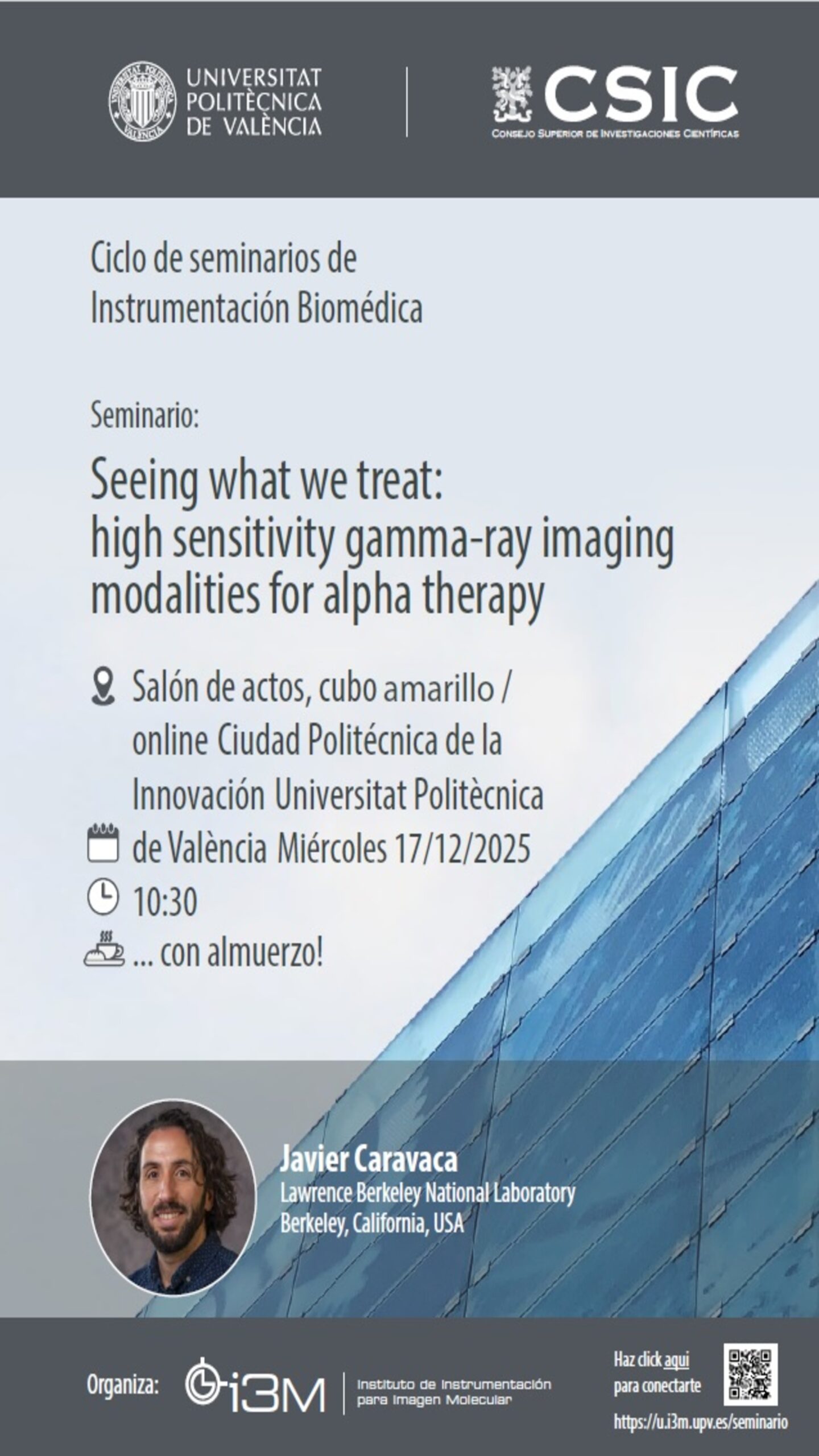
Ponente: Javier Caravaca
Título de la charla: Seeing what we treat: high sensitivity gamma-ray imaging Lawrence Berkeley National Laboratory
Berkeley, California, USA
Afiliación : Lawrence Berkeley National Laboratory
Berkeley, California, USA
Fecha:17/12/2025
Hora: 10:30 h
Lugar: Presencial en salón de actos cubo amarillo // online
Abstract:
During radionuclide therapy, radioactive isotopes are injected to cancer patients to selectively attack cancerous cells via targeting molecules. While this modality holds great therapeutic value, visualizing where these molecules accumulate within the human body is a challenge with current technology.
This is especially true in the case of targeted alpha therapy, where injected activities are orders of magnitude smaller than the standard. We explore gamma-ray imaging techniques that do not rely on collimators, thus enabling high-sensitivity detection of the gamma-rays emitted by the therapeutic radionuclides. We will discuss how we employ collimator-less modalities to generate images of the alpha emitter Ac-225 and its progeny in pre-clinical and clinical scenarios, opening a window to future high-sensitivity scanners able to visualize, monitor, and evaluate treatment in real time.
About the speaker:
As a Staff Scientist at the Lawrence Berkeley National Laboratory, my research is focused on the development and exploration of radiation detection and imaging techniques for nuclear medicine.
I dedicated most of my early research career to the field of fundamental neutrino physics and graduated with my PhD from the Universidad Autónoma de Barcelona on sterile neutrino searches. After my postdoc in the University of California Berkeley searching for neutrinoless double-beta decay in the SNO+ experiment, my research interest switched to applied nuclear physics. In the last five
years, I have established a research group whose main goal is to provide software and hardware solutions to pressing problems in nuclear medicine. In particular, we explore high-sensitivity imaging modalities for targeted radionuclide therapy and novel detector concepts to improve performance of state-of-the-art PET and SPECT scanners.